Suppression of Dengue through Deployment of Male Wolbachia-Infected Mosquitoes
1, Rajasekaran Subbarayan 1, Rupendra Shrestha 2*
Publications: The New England Journal of Medicine. 2026;395(6):623-624. doi: 10.1056/nejmc2605921
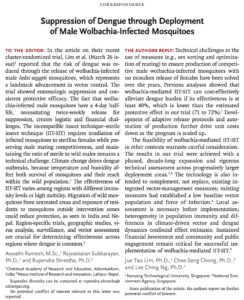
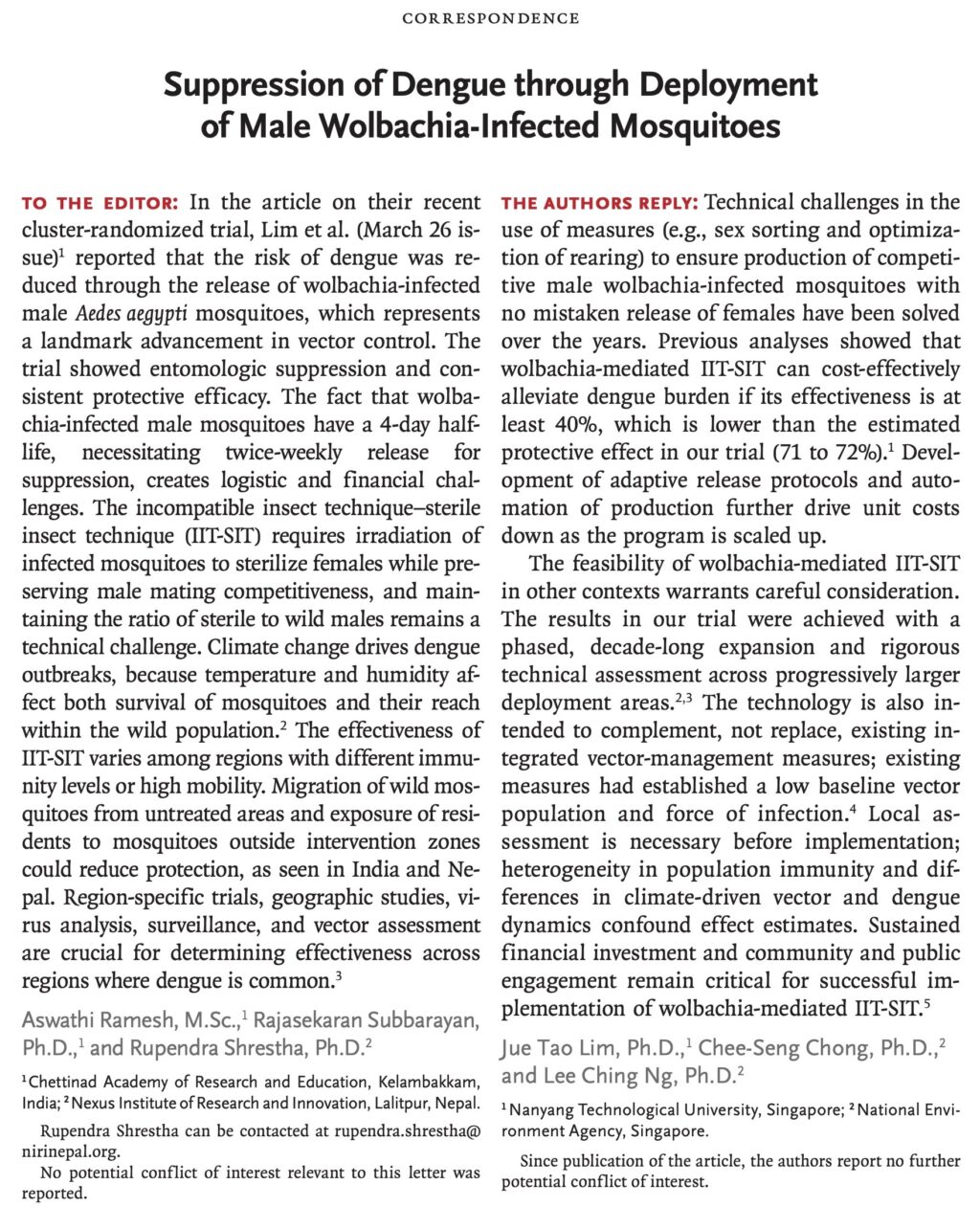
To the Editor: In the article on their recent cluster-randomized trial, Lim et al. (March 26 issue) reported that the risk of dengue was reduced through the release of Wolbachia-infected male Aedes aegypti mosquitoes, which represents a landmark advancement in vector control. The trial showed entomologic suppression and consistent protective efficacy. The fact that Wolbachia-infected male mosquitoes have a 4-day half-life, necessitating twice-weekly release for suppression, creates logistic and financial challenges. The incompatible insect technique–sterile insect technique (IIT-SIT) requires irradiation of infected mosquitoes to sterilize females while preserving male mating competitiveness, and maintaining the ratio of sterile to wild males remains a technical challenge. Climate change drives dengue outbreaks, because temperature and humidity affect both survival of mosquitoes and their reach within the wild population. The effectiveness of IIT-SIT varies among regions with different immunity levels or high mobility. Migration of wild mosquitoes from untreated areas and exposure of residents to mosquitoes outside intervention zones could reduce protection, as seen in India and Nepal. Region-specific trials, geographic studies, virus analysis, surveillance, and vector assessment are crucial for determining effectiveness across regions where dengue is common.
Cite: Ramesh A, Subbarayan R, Shrestha R. Suppression of Dengue through Deployment of Male Wolbachia-Infected Mosquitoes. N Engl J Med. 2026;395(6):623-624. doi: 10.1056/NEJMc2605921. PMID: 42555949.