Optimized polyethylene glycol precipitation yields high-purity, biologically active mouse liver tissue exosomes
1, Rajasekaran Subbarayan 1,2*, Rupendra Shrestha 3*, Ankush Chauhan 2
Publications: Mol Biol Rep. 2026;53(1):1369.. doi: 10.1007/s11033-026-12569-1
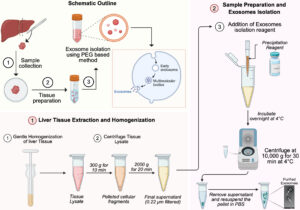
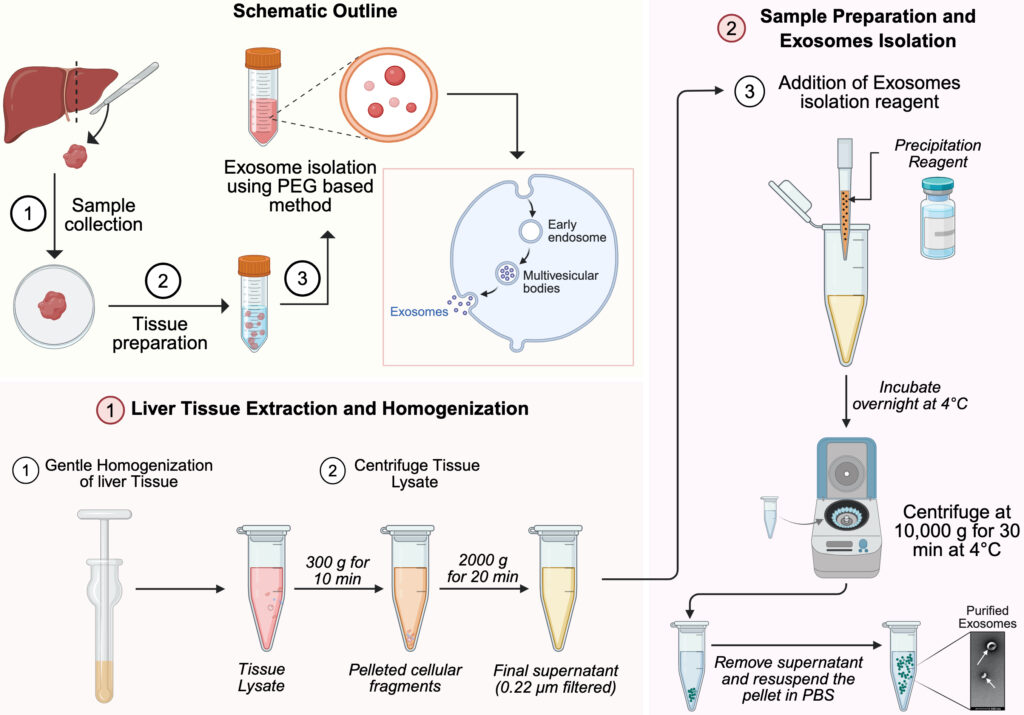
Abstract – Background: Exosomes are nanosized extracellular vesicles that play critical roles in intercellular communication and have emerged as promising tools for biomarker discovery, disease diagnostics, and therapeutic delivery. However, the widespread application of exosome-based technologies is often limited by the high cost and technical complexity of conventional isolation methods. Therefore, developing simple, scalable, and cost-effective isolation strategies remains a significant challenge in extracellular vesicle research. Methods:An optimized polyethylene glycol (PEG)-based precipitation method was developed to isolate liver tissue-derived exosomes from BALB/c mice and compared with a commercial MCE Exosome Isolation and Purification Kit. Exosomes were characterized using UV-visible spectroscopy, dynamic light scattering, zeta potential analysis, transmission electron microscopy, agarose gel electrophoresis, flow cytometry, protein estimation, and quantitative real-time PCR. The biological functionality was further evaluated by cellular uptake studies in HepG2 cells and in vivo biodistribution analysis using IVIS imaging. Results: Both PEG-Exo and MCE-Exo exhibited characteristic features, including nanoscale particle size, intact spherical morphology, negative surface charge, and positive expression of CD9 and CD63. PEG-Exo had a smaller average particle size and improved homogeneity compared to MCE-Exo. Exosomal DNA integrity was preserved in both groups, with fragments ranging from approximately 100-150 bp. Cellular uptake studies confirmed the efficient internalization of exosomes by HepG2 cells, and IVIS imaging demonstrated successful in vivo biodistribution after systemic administration. Overall, PEG-isolated exosomes exhibited structural, molecular, and functional properties comparable to those of exosomes isolated using a commercial kit. Conclusion: The optimized PEG-based method offers a robust, scalable, and cost-effective alternative for isolating exosomes from liver tissue, with significant potential for future applications in exosome biology, biomarker discovery, regenerative medicine, and therapeutic delivery.
Cite: Balakrishnan R, Subbarayan R, Shrestha R, Chauhan A. Optimized polyethylene glycol precipitation yields high-purity, biologically active mouse liver tissue exosomes. Mol Biol Rep. 2026;53(1):1369. PMID: 42573845.